
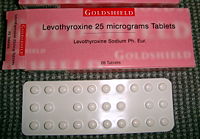
 Levothyroxine 25 mcg tablets
L-thyroxine (Levothyroxine Sodium,T4)
General information
T4 is pro-hormone, which your body converts into T3 at necessary rate only and thus it could be considered as much milder and safer drug than T3.
Levothyroxine sodium is an excellent fat burner since your metabolism is greatly increased while being on it. You can afford to be a little sloppier on pre-contest dieting since it will still burn fat when you are taking in a lot of calories since your metabolism is going haywire. It’s biological activity is 4-5 times less than liothyronine T3 if comparing mg to mg, however, hormonal levels remain more stable and price is also much lower. And there are some other unique advantages, which makes it very competitive with T3 such as appetite suppression, less need of sleep and increasing of physical durability (stamina), so question – “Which one is better?” depends on your goals.
Clinical pharmacology book by Goodman says: Liothyronine is less desirable for chronic replacement therapy due to the requirement for more frequent dosing (plasma t1/2 = 0.75 days), higher cost, and transient elevations of serum T3 concentrations above the normal range. In addition, organs that express the type 2 deiodinase use the locally generated T3 in addition to plasma T3, and hence there is theoretical concern that these organs will not maintain physiological intracellular T3 levels in the absence of plasma T4
Levothyroxine is widely used by bodybuilders and fitness addicts on pre-competition cycle in order to get relief, also used by overweighed people to reduce weight. It increases metabolism and produces general stimulating effects. However, this substance should be used wisely.
Dosage and Administration in fitness and bodybuilding
It is recommended that levothyroxine be taken with an empty stomach approximately half an hour to an hour before meals to maximize its absorption. It is also recommended that the patient take the tablet with one glass of water to ease swallowing as well as to help the tablet dissolve for absorption. Dosages vary according the age groups and the individual condition of the patient, body weight and compliance to the medication and diet. Maximum dosage may reach 400 mcg per day but that is rare. Monitoring of the patients condition and adjustment of the dosage is periodical and necessary
Most people need to be careful to start with a low dosage, about 25 mcgs. per day and increase by about one tab of 25 mcgs every 3-5 days.
On days that you take multiple tabs, divide the tabs evenly across the day (i.e. 100 mcgs. would be 4 doses of 25 mcgs. spread evenly across the day.) Don’t take for more than 5-7 weeks at a time to keep the thyroid functioning properly. After doing a cycle of this drug, make sure you go 4 weeks (better 8 weeks or more) before doing it again as to allow normal thyroid functioning to return.
Tables of Cycles
Cycle 1: classic
- Start with 25 mcg / day of T4 and increase by 25.
- Do 25 mgs of Metoprolol at the morning (this is beta-blockader, which eliminates heart overload and heartbeating). If heart rate at the afternoon is more than 70 beats/min, take 25 mgs more.
- Increase daily dosage of T4 to 150-300 mcg / ED split on 3-4 equal parts. The last one should be consumed before 6 p.m. At high dosages you can increase Metapronol to 100 mg / ED (two times by 50 mg), but in fact metapronol dosage should be found individually keeping heart rate between 60 to 70 beats / min. If heart rate is more than 80 – increase metapronol by 25 mg, if below 60 – decrease by 25 mg.
- Watch your blood pressure, it should not be higher than 140/100 mm Hg. Art. Metoprolol reduces blood pressure, too.
- Length of treatment should be 4-7 weeks. Do not quit suddenly, smoothly decrease T4 dosage starting 2 weeks before the end of cycle, this will help to restart your thyroid.
In case of diarrhea – use loperamid.
Minimal gap between cycles – 4 weeks
Cycle 2: Clenbuterol + L-thyroxin + yohimbine
When taken with Clenbuterol, this is the single best fat-burning combination that is available today (with the possible exception of DNP). It also helps to make steroids more effective since it is such a good aid for protein synthesis.
This powerful combo is used in some ready-made fat-burners, however, you can save a lot of money if acquire every of these substances separately. High effectiveness of the cycle is supported by the ability of T4 (or T3) not only increase metabolism and launch fat-burn) but also increase response of the receptors responsible for Clenbuterol and yohimbine.
Let’s consider ONE UNIT of this stack like following:
- Clenbuterol – 40 mcg +
- L-Thyroxine – 25 mcg +
- Youhimbine – 5 mg (you can acquire it in sport nutrition shops. If you can’t find it – just disregard)
Recommended cycle:
- Day 1-3: 1 unit
- Day 4-6: 1,5 units
- Day 7-9: 1 unit at the morning and 1 unit afternoon
- Day 10-12: 1,5 unit
- Day 13-15: 1 unit
- Day 16-19: 0,5 units.
- Day 20-21: 0, 25 units
Take 30 mins before breakfast with water.
After the cycle make 3 weeks rest before the new one.
In case of fever use 1-2 mg of ketotifin afternoon. For heart protection do beta-blockaders like metapronol 100 mg split on two times/day
Tricky ways of usage
Human body produces 90-110 mcg of l-thyroxine daily. For fat-burn it does not make sense to take just replacement dosages because your thyroid simply decreases production in response and you’ll come to what you started with – the same T3/T4 levels in your body. Thus you have to consume dosages, which are higher than natural. But it’s possible to cheat the gland. If you take 12-25 mcg once every three days it will not affect endogenous T4 production thus making aggregated level higher (!)
I.e. in order to encourage metabolism, optimal dosage is not replacement dosage, but a dosage, which can increase general hormone levels without affecting endogenous thyroid production! Replacement dosage may help only to the people with low thyroid production, but why take more risking toxic effects while you can use much lower dosages?
For instance, normal production is 100 mcg/daily. Patient has 80 mcg/ daily. If he takes 100 mcg / daily he’ll get back to normal, but natural thyroid production will be shut down. However, if he does 25mcg every three days, his body will still produce this very same 80 mcg thus making around 90 mcg in total. Got the idea? Anyway you should discuss this with your GP. For bodybuilding you can use the same scheme – either toy with high dosages or make just minor “tuning” with 25 mcg every three days.
This is safe way of usage, but, of course, effect is incomparable to 150-300 mcg/day. It’s advisable only for relatively small fat-burn.
Medical usage
This medicine is a hormone replacement usually given to patients with thyroid problems, specifically, hypothyroidism. It is also given to people who have goiter or an enlarged thyroid gland.
Precautions and side effects
There are also foods and other substances that can interfere with absorption of thyroxine replacement. Avoid taking calcium and iron supplements within 4 hours of the medication and avoid taking soy products within 3 hours of the medication as these can reduce absorption of the medication. Other substances that reduce absorption are aluminium and magnesium containing antacids, simethicone or sucralfate, Cholestyramine, colestipol, Kayexalate. Other substances cause other adverse effects that may be severe. Ketamine may cause hypertension and tachycardia and Tricyclic and tetracyclic antidepressants increase its toxicity.On the other hand Lithium causes hyperthyroidism by affecting iodine metabolism of the thyroid itself and thus inhibits Synthetic levothyroxine as well.
Synthetic levothyroxine may have adverse side effects like: palpitations, nervousness, headache, difficulty sleeping, insomnia, swelling of the legs and ankles, weight loss and/or increased appetite. Allergies to the medicine are unlikely, but if the patient develops a severe reaction to this drug such as difficulty breathing, shortness of breath or swelling of the face and tongue it is imperative that the patient immediately seek medical attention. Acute overdose may cause fever, hypoglycemia, heart failure, coma and unrecognized adrenal insufficiency. Acute massive overdose may be life-threatening; treatment should be symptomatic and supportive. Massive overdose may be a require beta-blockers for increased sympathomimetic activity. The side effects of overdosing appear 6 hours to 11 days after ingestion.
Prolonged use of high dosages in theory may lead to serious problems with thyroid and suppression of endogenous hormone production (fortunately, studies shows only 20% down after 3 weeks of usage). However, when used properly at recommended dosages, thyroid function restores after 3-4 weeks
Levothyroxin has adrenalin-like effects including increased heart rate and nervousness, which could be avoided by using beta-blockaders
Advantages
- Extremely powerful fat-burner in combination with clenbuterol
- Increased stamina
- Lower sides comparing to T3
- You can buy Levothyroxine T4 here
There are several reliable sources where you can buy anabolic steroids:
- You can buy anabolic steroids in Deep Web (TOR network) accessible only with TOR-browser
- You can buy anabolic steroids at 24Hours PPC