
 big image
30 caps x 20 mg, totally 600 mg
generic
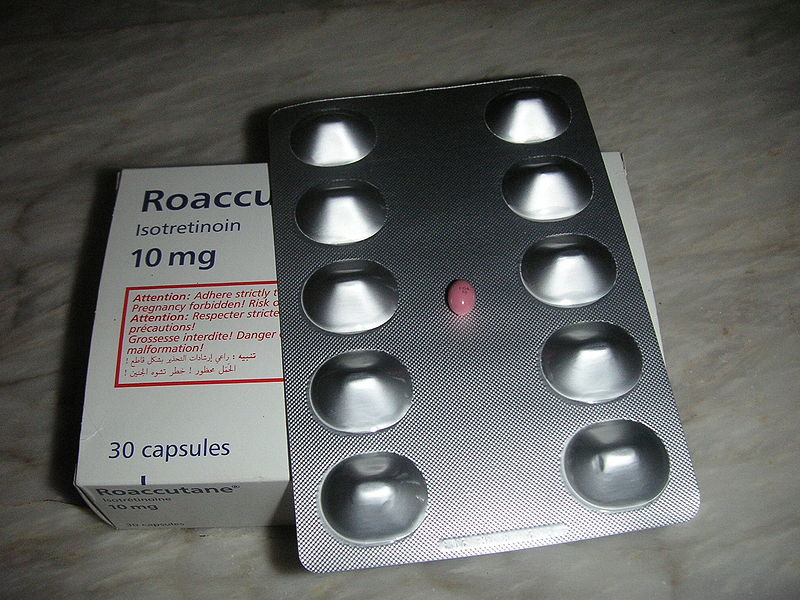
Roaccutance / Isotretinoin
Pharmacodynamics
Isotretinoin’s exact mechanism of action is unknown. Recent researchsuggests that the drug may amplify production of the antimicrobial proteinneutrophil-gelatinase associated lipocalin in the skin, thereby reducingsebum production. Generally, it is thought that similar to otherretinoids, the drug alters DNA transcription. The drug decreases thesize and sebum output of the sebaceous glands. It also stabilizeskeratinization, makes the cells that are sloughed off into the sebaceousglands less sticky, and therefore inhibits the formation ofcomedones.[citation needed] Isotretinoin’s combined impact on several ofacne’s contributory factors distinguishes isotretinoin from alternativeremedies such as antibiotics and accounts for its greater efficacy insevere, nodulocystic cases.
New studies have linked retinoids and other similar chemotherapy agents totelomere shortening, causing many to believe that telomere shortening isaccutane’s mechanism of action.Telomere shortening leads to an increase inthe rate of cell death within the body, which could possibly explain whyaccutane causes side-effects such as pre-epiphyseal closure, depression, andothers.
The effect on sebum production is temporary. However, remission of thedisease can be “complete and prolonged.”
Pharmacokinetics
Isotretinoin, when administered orally, is best absorbed when taken after ahigh fat meal, as it has a high level of lipophilicity. In a crossoverstudy, it was found that the peak plasma concentration more than doubledwhen taken after a high fat meal versus a fasted condition. Isotretinoin isprimarily (99.9%) bound to plasma proteins, mostly albumin. At least threemetabolites have been detected in human plasma after oral administration ofisotretinoin. These are 4-oxo-isotretinoin, retinoic acid and 4-oxo-retinoicacid. Isotretinoin also oxidizes, irreversibly, to 4-oxo-isotretinoin. Themetabolites of isotretinoin are excreted through both urine and feces. Themean elimination half-life is 21 hours, with a standard deviation from thismean of 8.2 hours.
Clinical use
Except in the most severe cases, isotretinoin is used only after other acnetreatments fail to produce results. Treatment of acne usually begins withtopical medications (e.g. benzoyl peroxide, adapalene, etc), followed byoral antibiotics (or a combination) and finally isotretinoin therapy. Thisis because other treatments, while less effective than isotretinoin, arethought to be associated with fewer adverse effects and lower cost. Thehigher cost is due to the medical supervision required in taking a toxicdosage. The cost of the medicine is also a factor (example: taking 5, 10, oreven 20 mg daily is far less expensive than taking 80 mg daily).
Indications
Isotretinoin is indicated for the treatment of severe cystic acne vulgaris.Many dermatologists also support its use for treatment of lesser degrees ofacne that prove resistant to other treatments, or that produce physical orpsychological scarring.
It is also effective for hidradenitis suppurativa and some cases of severeacne rosacea. It can also be used to help treat harlequin ichthyosis,and is used in xeroderma pigmentosum cases to relieve keratoses.Isotretinoin has been used to treat the extremely rare conditionFibrodysplasia Ossificans Progressiva. It is also used for treatment ofneuroblastoma, a form of brain cancer.
Prescribing restrictions
In the United Kingdom, this drug may only be prescribed by, or under thesupervision of, a consultant dermatologist. Because severe, cystic acne hasthe potential to cause permanent scarring over a short period, restrictionson isotretinoin’s more immediate availability have proved contentious. Similar restrictions are common in most Australian states ֠in New SouthWales and Victoria, for instance, the prescriber must be a Fellow of theAustralasian College of Dermatologists (FACD). In New Zealand, isotretinoincan be prescribed by any doctor but is subsidised only if prescribed by avocationally registered general practitioner or dermatologist.
Since 1 March 2006, the dispensing of isotretinoin in the United States hasbeen controlled by a FDA-mandated website called iPLEDGE ֠dermatologistsare required to register their patients before prescribing and pharmacistsare required to check the website before dispensing the drug. Theprescription may not be dispensed until both parties have complied. Aphysician may not prescribe more than a 30-day supply. A new prescriptionmay not be written for at least 30 days. Pharmacies are also under similarrestriction. There is also a 7 day window from the time the prescription iswritten in which the medication must be picked up at the pharmacy. If theoriginal prescription is lost, or pick-up window is missed, the patient mustre-qualify to have another prescription written. Doctors and pharmacistsmust also verify written prescriptions in an online system before patientsmay fill the prescription.
In at least Mexico and Colombia, this drug is of restricted use, and anofficial identification and patient signature is required by the pharmacies.
Dosage
10 mg capsule
The dose of isotretinoin a patient receives is dependent on their weight andthe severity of the condition. High dose treatments are administered between0.5 mg/kg/day to 2 mg/kg/day (usually at 0.5 to 1 mg/kg/day, divided intotwo doses), for a total treatment of 4ֶ months. A second course may be usedtwo months following the cessation of the initial course if severe acnerecurs. Efficacy appears to be related to the cumulative dose ofisotretinoin taken, with a total cumulative dose of 120ֱ50 mg/kg used as aguideline. High dose treatments should only be used as a last resortdue to adverse side effects.
Nearly all patients achieve initial clearing of acne during high-doseisotretinoin therapy. Furthermore, about 40% observe complete and long-termremission of the disease following one course of isotretinoin, while another40% eventually develop less severe recurrent acne which is treatable withless invasive medications. The remaining 20% relapse significantly enough towarrant an additional course of isotretinoin.
Lower dosage treatments, such as 10-20mg/day (approximately half the highdosage treatments above), are also highly effective, with greatly diminishedside effects. However, such lower dosage courses may be associatedwith higher relapse rates requiring additional courses of isotretinoin.
Preparations
Isotretinoin is marketed under many brand names by various manufacturers. Itis typically available as 5 mg, 10 mg, 20 mg, 30 mg and 40 mg capsules. Somebrands of oral isotretinoin include: Accure (Alphapharm), Accutane andRoaccutane (Roche), Aknenormin (Hermal), Amnesteem (Mylan), Ciscutan (Pelpharma),Claravis (Barr), Clarus (Prepharm), Isohexal (Hexal Australia), Istretinoin-A(Pharmathen), Isosupra (SMB Laboratories), Isotane (PacificPharmaceuticals), Isotroin (Cipla), Oratane (Douglas Pharmaceuticals),Atretin (Lafrancol), Nimegen (Medica Korea), Acnotin (Mega Lifesciences)and Sotret (Ranbaxy).
It is also available as a 0.05% topical preparation, marketed by Stiefelunder the trade name Isotrex or Isotrexin (with erythromycin).
Adverse effects
Increasingly higher dosages will result in higher toxicity, resemblingvitamin A toxicity.
Adverse drug reactions associated with isotretinoin therapy include:
Common: Mild acne flare, dryness of skin, lips and mucous membranes,infection of the cuticles, cheilitis, itch, rosacea, skin fragility, skinpeeling, rash, flushing, nose bleeds, dry eyes, diffuse alopecia areata, eyeirritation, conjunctivitis, reduced tolerance to contact lenses,hyperlipidaemia, raised liver enzymes, permanent thin skin, headaches,temporary/permanent hair thinning (this could start or continue aftertreatment), myalgia and/or arthralgia, back pain.
Infrequent: severe acne flare, raised blood glucose level, decreasedlibido/erectile dysfunction, increased erythrocyte sedimentation rate,fatigue.
Rare: impaired night vision; cataracts; optic neuritis; menstrualdisturbances; inflammatory bowel disease; pancreatitis; hepatitis; cornealopacities; papilloedema; idiopathic intracranial hypertension; skeletalhyperostosis; extraosseous calcification; psychosis; depression
There are spontaneous reports of premature epiphyseal closure in acnepatients receiving recommended doses of Accutane. The effect of multiplecourses of Accutane on epiphyseal closure is unknown.
The following adverse effects have been reported to persist, even afterdiscontinuing therapy: alopecia (hair loss), arthralgias, decreased nightvision, inflammatory bowel disease, degenerative disc disease, keloids, bonedisease. High dosages of isotretinoin have been reported to cause rosacea (adisease of severe facial skin redness and irritation).
Erectile dysfunction in the form of difficulty in maintaining erection wasreported in several patients in a clinical study.
While vitamin E supplements have been advocated by some to reduce thetoxicity of high-dose retinoids without reducing drug efficacy, test resultshave proven this to be false (though no indication of what form of vitamin Ewas used).
Patients with degenerative conditions, such as muscular dystrophy, shouldnot take isotretinoin as it may exacerbate and/or accelerate the underlyingcondition. This may be due to a suspected effect similar to acceleratedaging on the skin and tissues of the body, including muscle fibers.[citationneeded]
Patients receiving isotretinoin therapy are not permitted to donate bloodduring and for at least one month after discontinuation of isotretinointherapy due to its teratogenicity.
Teratogenicity (Birth Defects)
Isotretinoin is a teratogen and is highly likely to cause birth defects iftaken during pregnancy. A few of the more common birth defects that thisdrug can cause are hearing and visual impairment, missing or malformedearlobes, facial dysmorphism, and mental retardation. Isotretinoin isclassified as FDA Pregnancy Category X and ADEC Category X, and use iscontraindicated in pregnancy.
The manufacturer recommends that pregnancy be excluded in female patientstwo weeks prior to commencement of isotretinoin, and that they should usetwo simultaneous forms of effective contraception at least one month priorto commencement, during, and for at least one month following isotretinointherapy.
In the U.S. more than 2,000 women have become pregnant while taking the drugbetween 1982 and 2003, with most pregnancies ending in abortion ormiscarriage. About 160 babies with birth defects were born. Consequently,the iPLEDGE program was introduced by the U.S. Food and Drug Administrationon 12 August 2005 in an attempt to ensure that female patients receivingisotretinoin do not become pregnant ֠as of 1 March 2006, only prescribersregistered and activated in iPLEDGE are able to prescribe isotretinoin, andonly patients registered and qualified in iPLEDGE will be able to haveisotretinoin dispensed. The iPLEDGE program also applies to males, eventhough there has been no evidence of isotretinoin excretion through seminalfluids.
Depression
Several studies have suggested a possible link between isotretinoin andclinical depression.[38][39] Psychiatrist Dr. Doug Bremner found decreasedfrontal lobe function on brain imaging in patients treated with Accutane (isotretinoin).
The first scientific evidence of a link between a drug for severe acne anddepression was unveiled by Bath University in September 2006, followingyears of denials by Hoffmanna Roche that the prescription medicine couldbe in any way responsible for suicides.The research showed that the drug,which had been given to British teenagers for more than two decades, causesdepression in mice. Biochemist Dr Sarah Bailey looked at how healthy micewere affected by a six-week course of Roaccutane, which has a similarstructure to vitamin A. She found that when given levels of Roaccutaneequivalent to those used to treat teenagers, the creatures developedsymptoms of depression, stress or despair.
One study utilising positron emission tomography (PET) found that patientstreated with isotretinion experienced an average twenty-one percent decreasein frontal-lobe brain activity but showed no changes in depressive state inthe patients that could be measured with the Hamilton depression scale. Thisfinding has prompted members of the scientific community to call for morestudies regarding isotretinion’s links to depression and suicidal behavior.
Various case reports of depression, suicidal ideation, suicide attempt, andsuicide in patients treated with isotretinoin have been reported to the U.S.FDA Adverse Events Reporting System, with 431 cases reported between 1982and May 2001 ֠of these, 37 patients had committed suicide. Thissuicide rate is in line with national rates and does not exceed the nationalaverage.
Studies have shown that patients with acne, the population group eligible toreceive isotretinoin therapy, have an increased risk of clinical depressioncompared with the general population. Chee Hong describes Isotretinoin-relateddepression as “an idiosyncratic side-effect”, claiming, often anxiety canbring on acne and depression, creating more anxiety Correspondingly,treatment of severe acne with isotretinoin has been shown to reduce anxietyand depression, for tests have shown acne to be a main depressant in mosttested patients’ lives.
U.S. Representative Bart Stupak (D-MI) believes unadvertised psychologicalside effects from the drug drove his teenage son, Bartholomew Thomas StupakJr., to commit suicide in 2000.
Crohn’s Disease and Ulcerative Colitis
Several scientific studies have posted that isotretinoin is a possible causeof Crohn’s Disease and Ulcerative colitis in some individuals. Three casesin the United States have gone to trial thus far, with all three resultingin multi-million dollar judgments against the makers of isotretinoin; thereare an additional 425 cases pending.
Advantages of Roaccutance
- Powerful way for acne treatment, but should be used extremely carefully
- You can buy Roaccutanehere
There are several reliable sources where you can buy anabolic steroids:
- You can buy anabolic steroids in Deep Web (TOR network) accessible only with TOR-browser
- You can buy anabolic steroids at 24Hours PPC